Author: admin

Untouchables at Long Goodbye – May 18, 1980

I have now found a part of Chris’ draft memoir that claims that The Untouchables did play on the night of the Mt St Helens eruption, at the Long Goodbye. It was possibly their first show in Portland, but it’s hard to tell as Chris was writing stream of consciousness and he would veer off on tangents. So it is possible that May 18, 1980 was the date of The Goners/Untouchables first show with Longview band, ALOST. However, Chris was pretty clear that the show where he met Greg Sage was the following June with Fred and Toody’s The Rats and Tom Roberts’ Imperialist Pigs. (Chris would never call Roberts by the “Pigg” nickname which he found insulting.)

Untouchables first show at Long Goodbye – 1980

With regards to the Danielson biography, I’ve realized that what started out as a seemingly minor detail and/or – depending on what you’re willing to see – a red flag – in Chris’ story – deserves a bit more attention. (There are actually a number of these “minor detail red flags” but anyway – this is one.)

This is the issue of the Mt St Helens explosion on May 18, 1980, which, according to Eric Danielson, was the same date that Chris’ band The Untouchables played their first show in Portland (Rocky Road To Recovery, p 13). Unlike the date of Snow Bud’s first performance in 1986 coinciding with the Challenger disaster, I personally don’t recall Chris mentioning this date link (1/27/22 note – see here for update). Eric does not provide the source for this claim, and I can’t find any corroborating data online. This seems to be new information, as it does not appear in Danielson’s 2010 essay.

The more I dig into this assertion, the more threads of all different types seem to begin to untangle, some of these being significant to Chris’ life, others being significant to gaining insight on a number of other issues from the history of northwest music.

So let’s start with the assertion itself – something that, unless there is some other indisputable primary source that Danielson had access too – should ideally have been confirmed with Chris while he was alive. Was the Untouchable’s first gig in Portland on May 18, 1980? And did they play with The Rats at the Long Goodbye, with Greg Sage in the audience?

Based on Chris’ writings, the venue is correct – their first show was at the Long Goodbye – but I can’t confirm the date and the reported line up doesn’t match. Chris wrote in a draft memoir that The Untouchables first show was at the Long Goodbye, and that they opened for a Longview band called ALOST. Further examination, however, shows that in fact, Chris’ band was at that time, indeed called The Goners. However, according to what ALOST reported to Chris, the band was listed on the poster advertising the show as The Untouchables. In other words – for some reason – the club itself changed the band name on the poster, and Chris and the boys just rolled with it. They became The Untouchables.

Could this shine light on the March 31, 1989 poster for Pine Street Theatre swapping the band name Alcoholics Unanimous with Mudhoney? It remains a mystery.

In any case, this incident shows, from my perspective, how suggestible Chris could be, and how casually he could accept some things, like the changing of his band name, that others (such as myself) might take much more seriously.

Other than Chris’ narrative, I am unable to find any additional information on the band that was called ALOST – including when they played at Long Goodbye. If nothing else you can say that ALOST band lived up to their name.

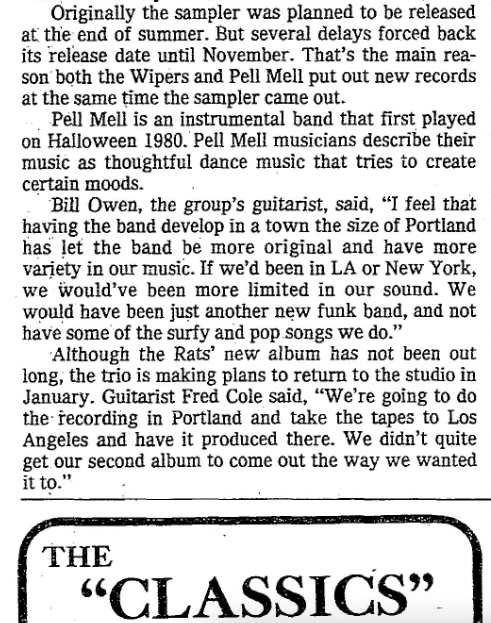
According to Chris’ draft memoir, the show that Danielson is referring to – where The Untouchables played at the Long Goodbye with the Rats, and Greg Sage in the audience, was in June 1980. In his writings, Chris says on that night there were “Four awesome bands” and notes that The Rats were headlining – but he goes on to list only three bands in total. The line up he lists was The Imperialist Pigs – a proto-Poison Idea band fronted by Tom Roberts (who died in 2006, age 47); The Untouchables (specifically, Chris Newman, Mark Nelson, Dave Koenig, Chon Carter); and The Rats – Fred Cole, Toody Cole, and Sam Henry. Sam had recently left the Wipers. This was the show with Greg Sage in the audience.

If I had to guess – I’d suspect that Chris writing “four awesome bands” was an error – that he had the image of Greg Sage in his head which glitched his memory – but the Wipers didn’t actually play that night.

Did Chris know for a fact that this was June 1980 and not May 18? I don’t know, but the sense I get is that not only was this not the first show that he played at the Long Goodbye – that The Untouchables had already played a few shows, mostly at the Long Goodbye, and Chris seems to have felt that Sage may have been there specifically to see The Untouchables perform.

It seems that this given date of May 18, 1980 being a “first” for The Untouchables is not correct, and without any corroborating evidence it’s hard to know if The Untouchables even played on this date. If they did – where’s the source?

Why do I call this detail a “red flag”? For a couple of reasons. First, in terms of the history of the band – if Danielson cannot provide a source or any corroborating evidence for this claim – it means that it’s just something he heard or even something he made up. This, along with a refusal to acknowledge or correct false information when presented with conflicting evidence from primary sources – makes him a profoundly unreliable historian. And this is a bit remarkable, considering that, according to his Amazon author’s bio, he has a journalism degree (B.A. Western Washington University, Bellingham) and two history degrees (B.A. University of Washington, Seattle; M.A. George Washington University, Washington D.C.).

Mind you – this is just one of Danielson’s many problematic or demonstrably false claims. And with so many problems in this document, it’s hard to wonder if there’s a reason why this came after Chris’ death. It’s particularly important because when not much work has been published about an artist, every work that is published has greater weight, and false or misleading information can be carried from one document to the next. And if you don’t cite your sources, it can be near impossible to trace down where anything came from.

This, by the way, has been an ongoing issue between me and other historians of northwest music. Some are more problematic than others, but all seem to be actively hiding or altering certain bits of information.

The other reason I called this detail about the Mt St Helens eruption a “red flag” is that there does in fact seem to be some strange connections to Mt St Helens in terms of dates, names, locations, etc. Whether that’s something I want to get into – or at the risk of sounding a bit paranoid – whether it was a trap Danielson laid for me – I haven’t decided.

painting of post-eruption Mt St Helens from Kurt Cobain's collection
Cross, Charles – Cobain Unseen (2008) – p 98-99
image from Kurt Cobain’s collection described as “landscape painting” is clearly post-eruption Mt St Helens with writing across the top, reading “Frances Farmer will come back as fire to burn all the liars and leave a blanket of ash on the ground”

Corrections to Eric Danielson biography of Chris Newman

This is a list of corrections to Eric Danielson biography The Rocky Road to Recovery: The Life of Chris Newman of Napalm Beach and some additional information. I consider this document a work in progress.

p 6 “written more than 1000 songs…”

This statement was actually a point of contention when Danielson first wrote his essay Chris Newman of Napalm Beach: The Road To Recovery

What I think happened was this – in the months before this 2010 essay was published, Danielson conducted a series of interviews with Chris, I believe mostly over the phone. Chris would drink some beers as these interviews were conducted. At some point, Danielson asked Chris how many songs he’d written in his lifetime, and how many were recorded and Chris answered off the cuff – probably saying he’d written around a thousand songs and recorded 400 of them.

I do not believe, first, that Chris really knew how many songs he had written, and I don’t think he sat and thought about what constitues a completed song. He didn’t often exaggerate but this appears to be either exaggeration or an error. Chris was pretty consistent about listing his published works with BMI in hopes that one day they would pay off in terms of licensing, and at the time of his death, he had 371 songs registered.

When Danielson first published his essay, I recall that we caught this error, and Chris informed Danielson that the number was not correct. Eric’s response was to argue with Chris, saying “you clearly said…” – in other words, he did not allow Chris to correct the error. Now Danielson has repeated the error in this book.

As for the number of albums with each specific band, I don’t have enough first hand knowledge to confirm or deny the statements, except for Divining Rods (the number is correct, two albums were released) and Boo Frog. Boo Frog released three – not four – albums. The album which was supposed to be our fourth album, Beachcomber, was not really a Boo Frog album. Chris released it as a solo album. I did not play on it or write any of the songs. There are many other problems with how this recording and release came about, but now is not the time to get into that.

With regard to the list of siblings, Chris’ sister Cindy’s full married name is listed, but not Becky’s married name. Her name is Rebecca Ruth White.

My understanding is that Chris joined Bodhi in 1971 at age 18. What I think is notable about this band is that in addition to being the youngest member, Chris was the singer/frontman, lead guitar player, and as far as I know, was the band’s sole songwriter. I do not recall Chris ever saying that Dave Minick was a member of Bodhi. (The drummer’s nickname was Spyder, however – did that make Bodhi the “spyders from Mars”?)

Danielson mentions a (circa 1972 or 73) band photo of Bodhi – when I first published this photo on my 2013 essay “Introducing Napalm Beach” I cropped the top and bottom to focus on the band. Later on I took a more careful look at the original photo and realized that the original seemed to feature – rather than the band itself – a collection of mountainous mole hills in front of the band.

photo showing Washington state rock band Bodhi standing in a field with mole hills in front, trees in back

With regards to speculating that Minick may have been the bassist in this band – I’m not trying to be surly but this is from my perspective a serious issue – a problem with Danielson’s entire book is that there are passages like this which appear to be pure speculation – speculation which could easily be put to rest with a simple phone call or email to the appropriate party. In this case, Dave Minick himself should have been queried.

This band, Bodhi, by the way, and this time period, was the source of a lot of Chris’ exposure to drug use. I don’t know if this didn’t come up during Chris’ interviews with Danielson – but the influence on Chris in years to come was significant.

“He moved down to Santa Monica, CA…” In 1974 Chris moved to Malibu.

p 7 Chris, for whatever reason, did not consider The Goners to be the same band as The Untouchables or Napalm Beach. It may have been about the music or about the band members. He did consider The Untouchables to be the same band as Napalm Beach. I’ve written more about this here:

Napalm Beach – some corrections and clarifications

Regarding Chris’ bands after 2004, in addition to Divining Rods, Lost Acolytes, Boo Frog, and Deluxe Combo, there was also a short-lived trio called Chris Newman Experiment which released a single album, La Rose Noire, in 2008.

p 10 “Although an amazing guitar player whose style of playing reportedly had an early influence on Mark Arm of Mudhoney…” – there are a whole lot of problems with this phrasing. The way this refers to Mark Arm was another thing that Chris was not comfortable with when the original essay was published, and it was another thing that Danielson pushed back on altering. The relationship between Napalm Beach and Mudhoney seems to have been significant, but Mudhoney was far from the only band to be influenced by Chris – and it wasn’t only his guitar playing that was influential – it was also his songwriting, vocals, artwork, gear, recording and DIY distribution techniques. For a time, Napalm Beach was very closely associated with The Wipers, and Chris, along with his contemporaries, were influence by Greg Sage. Others, in turn, were influenced by Chris. And in terms of Mudhoney’s guitars specifically, it’s arguably Steve Turner who took more influence from Chris. There is even a Melvins song that appeared on their 1986 self-titled EP (and on their LP Gluey Porch Treatments which came out later the same year) called “Disinvite” aka “Steve Instant Newman.” There is likely a very specific reason for the title of this song. This is another topic that needs more careful and accurate attention.

“sign painter… this skill…enabled him to acquire the famous Flying V guitar… indirectly led to the 1984 recording of the Napalm Beach Teen Dream album” – I simply don’t understand this sentence. Possibly Danielson is saying that Chris’ work as a sign painter allowed him to save up enough money to buy the Flying V – but how did it figure into the recording of Napalm Beach’s debut album? It’s not clear from the writing and it’s not something that I know the answer to, either. I suspect that the recording of the album that became known as Teen Dream (but technically was a self-titled album called Napalm Beach) was financed by Doug Reed who is in possession of the master tape.

Speaking of sign painting as a family profession, who remembers The Five Man Electrical Band 1971 song “Signs”? The song starts with a young man hired for a job, then removing his hat to show his new boss his long hair. Chris worked during this era (1970-71) at his dad’s gas station where was asked to keep his long hair up under a hat. This is the kind of “match” that happens all the time.

Who remembers the song “Matchbox”?

This is a digression, but in truth, none of these matches – often with creative material by entities which had no direct contact with Chris or his friends – are incidental to Chris’ story – beginning, middle, and end.

p 12 “Luke Pyro on drums” – who remembers a band called Porno for Pyros?

p 13 a side note about the May 18, 1980 eruption of Mt St Helens that coincided with The Untouchables first show in Portland – this was when Chris began to experience asthma attacks which he attributed to the ash that was in the air from the volcanic eruption. He had asthma for the rest of his life. Somewhere I recall seeing a painting made or owned by Kurt Cobain of Mt St Helens with lyrics from his song “Francis Farmer” written around it. (note: It appears to be page 98-99 of Charles Cross’ 2008 book Cobain Unseen – weirdly, Cross doesn’t identify the “landscape” as Mt St Helens – thought it’s an iconic image – more on this later, perhaps.) As for me, I taken a lot of photos at Mt St Helens around 2011 which went missing, and are still missing today. Not only that, but a high resolution scan of a photo I made at the top of the mountain (basically, the exact view shown in Cross’ book mentioned above) is among the many files that vanished from my hard drive.

“they reportedly once had an offer from A&M records” – This is another unsourced rumor. Who reported this? I never heard about it and it does not appear in Chris’ writings. Same with “several abortive attempts at recording in the studio.” There do seem to have been some unmixed, unreleased Untouchables recordings done at Wave studios and maybe there was another recording session that was unreleased. (Note – Danielson seems to get more specific about this later in the book – in addition to fact checking, the book could really use an editor.)

p 14 “the band’s name was changed” – the name change is also is addressed in my article Napalm Beach: Some corrections and clarifications.

With regards to Mark Nelson not playing on Trap Sampler or Rock n’ Roll Hell, I’ve found it difficult to keep track of when Mark was, and was not, in the Untouchables and Napalm Beach. He seems to have come and gone a lot. Chris seems to have learned to keep moving ahead regardless of obstacles like losing a band member, which happened a lot.

p 15 who said that The Untouchables “blew (Joan Jett) off the stage”? Why the use of passive voice? Usually if it was Chris telling these stories, he would name the person who said something. That way, the source could be contacted for confirmation or additional information. As it is put here, it just comes off as an unsourced rumor or braggadocio.

p 16 “It was so bad that afterward Fred Seegmuller decided to quit the music business…” – I hate to sound like a broken record but who made this claim? I’ve never heard this. It is true that, based on what Chris told me, the clubs where Napalm Beach were accustomed to playing seemed to all close down at once – maybe even simultaneously in Portland and Seattle – resulting in a sort of a dead space around 1982-83 – a vacuum that was then filled by the opening of Club Satyricon (see pages 32-33). But I never heard anything about Urban Noize closing because of the Johnny Thunders show – so I don’t think the information can be considered to be self-evident. It needs a source.

Similarly, there’s more to the May 1981 April Wine show. I recall Chris mentioning that Mark Nelson was really copping an attitude with the audience, apparently in an effort to be extra “punk rock.” Another thing Chris told me is that they opened with the song Angels Ride, which that particular audience loved, but the following songs were too New Wave for them. Also, Dave Koenig did not quit the band, he was fired. Chris didn’t feel he had the right image, and apparently Mark Nelson – who seemed to be a strong influence on Chris at that time – didn’t like him.

p 17 “The Untouchables members attended the legendary U2 show at Astor Park in Seattle on March 23, 1981… afterwards they were so inspired or enraged by it that The Untouchables headed down to the Gorilla Room in Pioneer Square in a sadomasochistic rage, forcibly pushed the off the stage in the middle of their set, and started playing an impromptu set of their own until they collapsed in bloody exhaustion.”

So much to unpack here. The description is so colorful, you’d almost thing that Danielson was either there, or had interviewed numerous sources – except that no sources are cited for this particular passage. The band is “inspired or enraged” and in a “sadomasochistic rage.” I strongly suspect this entire passage is based on Charles Cross’ July 18, 1981 article in the Seattle Post Intelligencer called “Band Drives Stake Through Heart.” Specifically, the following passage – “After seeing the young Irish band U2 earlier this year, the Untouchables invaded the Gorilla Room literally forcing the band that was playing off stage, and proceeded to play until their fingers bled.”

I think it’s useful to compare the two versions, and important, and the reason I believe it is important is what I see happening is a gradual build-up, drip by drip, painting Chris’ bands, and Chris and particular – as being dangerous and out of control. There’s been more to this effort than colorful writing, but that’s a subject for another day.

If Danielson had another source for his description, I don’t know what it is. But if he was in fact basing his description on the writing of Charles Cross, why not cite the original article which had been published on our websiste since 2011 (Skullman Records: Charles Cross on The Untouchables/Napalm Beach – Seattle P.I. July 1981)? My suspicion is, based on the article as a whole, that Cross was already amping up the color in the description. So why did Danielson feel the need to amp it up even more, adding phrases like “sadomasochistic rage” and “collapsed in bloody exhaustion”?

The exact date of the show, by the way – March 23, 1981 – noted by Danielson, but not by Cross – jumps out at me because it is just 8 days before the assassination attempt on Ronald Reagan which was March 31, 1981 (“Honey, I forgot to duck”) – and this in turn seems to be significant because of subsequent events happening on or around the same day including, but not limited to, the death of Jeffrey Lee Pierce by stroke or aneurism on March 31, 1996. Note also the use of the word “duck” in the Otis P Otis quote on page 16 – “opening for April Wine… band ducks flying objects and fist fights.” Over the years I’ve come to understand that “duck” is widely-used code for someone who manipulates another person through covert medical means – including altering their personality, inciting events – including accidents and violent events, and creating disease states, including strokes, heart attacks, cancers. It’s often snuck into phrases and imagery in seemingly innocuous ways which are actually quite meaningful.

There also seem to be ongoing parallels drawn between Napalm Beach and the band U2. For example, the cover for Napalm’s 1991 Thunderlizard album seems to be almost a replica of U2’s 1987 blockbuster album The Joshua Tree. Chris seems to have rarely been asked for input into his own album art. He could not figure out why there was a photo of a Joshua Tree on the album, rather than, say, a dinosaur (thunder lizard). Why this parallel between Napalm Beach and U2 exists is not entirely clear to me, but it seems to come up again and again.

p 18 – Where is page 18? On my copy of the book, there is no page 18.

p 19-20 Here the 1981 Charles Cross article appears – why did Danielson quote from the article here, but not on page 17 where the description appears to be based on the same article?

And I have to ask – why does Danielson end on page 20 with the phrasing “he compared favorably to a combination of Velvet Underground, 999, and U2”? 9 times 3 is 27 – this is a number linked to deaths (two is linked to twins and seven to the chariot in Tarot, which I interpret as speed). And U2 is a rocket made by Lockheed. There is a big black space after this phrase – as if a chapter is ending – but then the narrative simply picks up again on page 21. Is there a reason that it was important for Danielson to do this? Or for that matter, to leave out page 18? Were these glitches in a self-published work or is there a numerology subtext going on here? (Note that the book’s introduction is dated September 12, 2022.) Maybe Danielson was going to create separate chapters but didn’t get around to it? It’s a mystery to me.

p 21 The Untouchables are said blow another band “off the stage” – this time it’s The Cowboys – and the comment is sourced.

p 22 “a hit song called ‘Twinkie Madness'” – how, exactly, was Twinkie Madness a “hit song?” And/or is Danielson insinuating a double meaning in the word “hit”? The song Twinkie Madness was about the Nov 27, 1978 assassination of San Francisco Mayor George Moscone and Supervisor Harvey Milk.

It appears that Twinkies were originally packaged in sets of two (twins). The lyrics to Twinkie Madness are available online.

p 23 “Kurt Cobain’s future wife Courtney Love tagged along with the band from Portland to Seattle” – besides noting that Courtney Love has done more in her life than marry Kurt Cobain – I address the van rumors in
Napalm Beach – some corrections and clarifications
and I published Chris’ words about his friendship with Courtney here.

But to re-iterate – I’ve heard multiple salacious stories about teenage Courtney in the Napalm Beach van and Chris was not able to confirm any of them. From my point of view, it’s unfounded gossip that should not be going into a biography of Chris.

Also, I want to clarify that according to Chris, Courtney Love only lived in the band house for a period of about six months in 1981. She did not live there in 1982. In fact, I suspect she traveled to England and Ireland shortly after that HUB show, returning to Portland again in 1982, which I suspect is when she met Rozz Rezabek (also mentioned by Danielson on page 23).

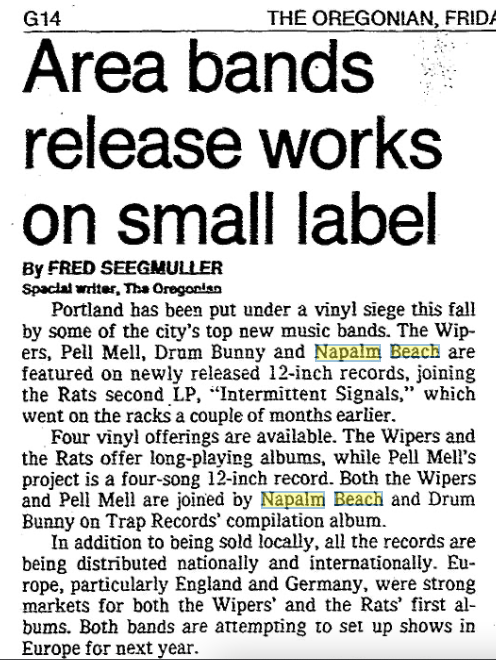
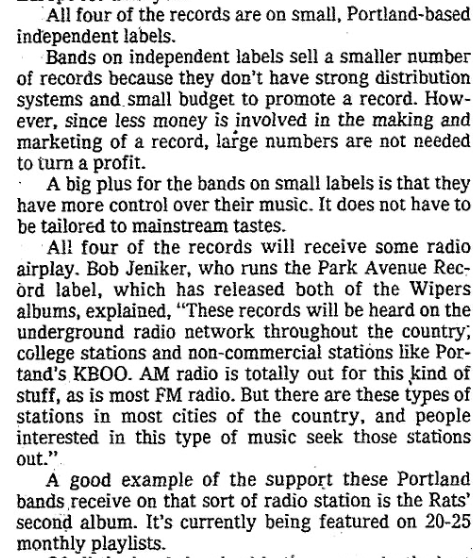
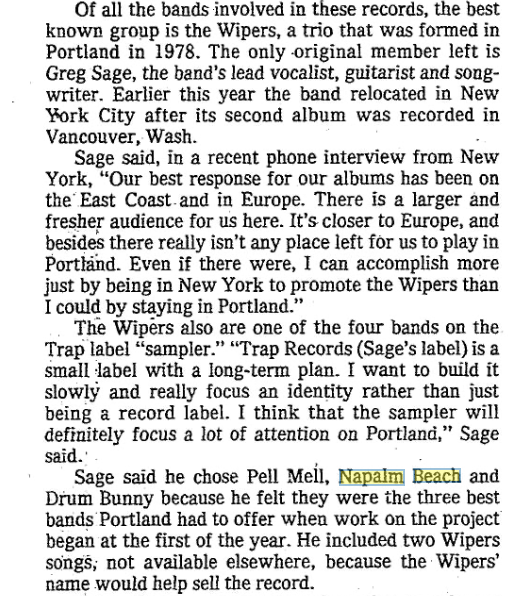
p 25 Danielson discusses Chris’ work at Wave Studios and avoidance of commercial success. It should be noted that Chris was, at this time, working very closely with Greg Sage of the Wipers. Sage was in fact engineering the Wave sessions. Sage is probably, more than anyone else in the pacific northwest at that time, responsible for the “stay small, don’t sell out” mentality. Sage and many people around Tom Robinson also seem to have been closely linked to Calvin Johnson in Olympia, Washington – who was at this time running a fanzine called Subterranian Pop with Bruce Pavitt, who had recently moved to Olympia from Chicago, Illinois. Beginning in 1982 Pavitt also managed a Portland band called Pell Mell who, along with Untouchables/Napalm Beach, appeared on Sage’s 1981 Trap Sampler.

p 25 just a note that The Wrex was the club that later became The Vogue – known for showcasing the early Sub Pop bands.

p 27 I think that Chris at one time explained to me that he specifically did not want Sam to play drums on Volunteer. It might be that they were not getting along. If you look at the discography you can see that in a lot of ways, 1993’s Curiosities was the band’s Swan Song. I know that Chris really thought Curiosities could do something, and that when he still could not get traction, while all these other northwest bands were rampaging into fame and fortune, he was pretty disheartened.

p 28-29 The story of Napalm Beach, X, and the stolen amplifier is another one to revisit a bit more carefully. I believe that Danielson is basing his writing here on his interview with Chris. There are a few details that seem to be slightly off. I don’t recall Chris saying that he was “mauling” Exene – more that he was putting the moves on her (verbally). The description of X feeling like “they had just barely escaped being raped and pillaged by a gang of wild maniacs” appears to be more colorizing – did Exene and John Doe say this to Danielson – or to someone else? Because I never heard Chris say anything like this. The only ones who know how they felt that night would be Excene and John Doe. And like so many others, they could have been asked (and still could be asked) to share insight on this incident.

Also – Chris told this story to me, and/or in my presence more than once in our first years together – the letter from X’s management, according to Chris, did not use the phrase “violent behavior” but, “unprofessional behavior.”

There is another part to the X incident, something that Chris never seemed to pick up on – which is that it mirrored another pivotal incident earlier in his life, having to do with a stolen amplifier. Chris was in his first or second year of high school when a friend of had an amplifier stolen. Chris found out who stole it, and told his friend, who was able to get his amplifier back, but the incident resulted in Chris being ostracized and harassed for being a “snitch” to the point that he was in fear of his life and ended up being sent to boarding school in Canyonville, Oregon as a means of escape. This in turn mirrors something that happened in my life – it seems that these boarding schools were places to introduce us to people who would become key at later points. In Chris’ case, it was his friend Russ and Ray. In my case, it was Erika Schlaeger.

p 30 Danielson mentions Napalm Beach playing at the Golden Crown in Seattle July 30 and 31, 1982 saying that there is a bootleg that was “made by Mike Refuzor” and uploaded to YouTube in 2013. I am wondering here how Danielson knows that this bootleg was made by Mike Refuzor (Mike Lambert) – and whether Danielson had access to the bootleg before it was put onto YouTube. The YouTube channel where this video appears has the username “imarefuzor” but is run by a photographer named Mike Leach. This is not the same person as Mike Refuzor. Is Danielson confused by the username, or does he have some other knowledge about this bootleg?

Mike (Refuzor) Lambert apparently just dropped of a heart attack, aneurism, or stroke, while walking down a Seattle sidewalk on March 3, 2018. A few things about this stand out for me. It echos sudden drop-dead deaths of other contemporaries from the same scene of Portland and Seattle musicians including (but not limited to) Stephen Spyrit and Steve “Slayer Hippie” Hanford of Portland. It occurred on 3/3 which as to my understanding was also the date of Kurt Cobain’s first 1994 suicide attempt in Rome, Italy. And – and this is grim, but typical of the dark irony around these events – the Refuzor’s best known song was called “Splat Goes The Cat.”

The thing about these 1982 Golden Crown bootlegs is not only do they feature songs that may not be available on any other Napalm Beach recording, but Chris is clearly using a Small Clone/Big Muff fuzz effect combination – the same sound that Nirvana would later become known for. So it would be interesting to learn the real provenance and history of the Golden Crown bootleg, and it would also be interesting to learn what other Napalm Beach bootlegs are out there.

Also – I think it’s worth mentioning – one of the songs from this set, which features the small clone and big muff combination, is called “Into The Sky.” Chris told me specifically that people in Seattle did not seem to like this song, and that was part of the reason why he ultimately dropped it from his repetoire, and never put it on an album. Also kind of ironic, considering what would a few years later would start to be called the “Seattle sound.”

p 32

“It was even said that the band members slept in the basement below the club” – yes, Chris did say that. It sounds like it was something they were permitted to do after a show. The Met also seems to have been a favorite venue of teenage Courtney Love.

By the way – were there two clubs – one in Seattle and one in Portland – called The Metropolis or The Met? (The Portland version later became Dante’s Inferno). Similarly, there was a venue in Seattle and a club in Portland both called the Paramount – and not only that – they both seem to have opened almost exactly the same time – March 1928 – and they had nearly identical, iconic lit signs.

The Wikipedia page on Paramount Seattle claims that “Hollywood-based Paramount Pictures constructed a grand movie palace in practically every major city in the country, many erected between 1926 and 1928” with a footnote linking to a Seattle Times article behind a firewall – but is this true? Are (or were) there Paramount buildings all over America?

Portland also has movie theatre called Hollywood Theatre, which in July 1926, for which the Hollywood district is named.

Regarding Chris and the Cramps – there are a few stories to tell here, but as far as Chris’ sound, the Cramps’ use of the Fender Twin amplifier was an influence on his sound, as I believe he tended to use favor the Marshall before seeing the Cramps. Chris seemed to feel that the Cramps were more of an influence on his Snow Bud sound where he used a Fender Twin, big muff fuzz, and wah pedal. (Chris was very good with a wah and could indeed play a lot like Hendrix.) I guess another thing I’d add is that on this first night when Chris saw the Cramps, Ivy told him she’d heard he was in a band, and asked him how come his band wasn’t playing with them. In fact, Chris seems to have never been asked to open for the Cramps in Portland or Seattle. It seems to have always been Mark Sten’s bands that were chosen.

p 34 “…in January 1983 Napalm Beach briefly tried moving down to San Francisco… this is when both Chris and Sam Henry first started experimenting with heroin. Chris said he only tried it once and didn’t do it again for another two years after that… but Sam Henry immediately became hooked.” This is not correct.

I covered the “who started using heroin when” issue in my earlier article called Napalm Beach – some corrections and clarifications. Briefly, Sam was already involved in heroin when he was still with the Wipers. I don’t know when Minick started, but he was the first to give some to Chris. I don’t know what year it was, only that it was no earlier than 1981 and no later than 1983. And it is true – there is no reason for Chris to lie about this – that Chris did not try it again until two years later.

You don’t immediately become hooked on heroin, generally speaking. It’s a physiological and psychological dependance that requires repeated use. (I myself have never tried heroin, but I’ve studied drugs, addictions, recovery.)

p 36 “fortunately the call was intercepted by Chris…” I believe that actually Greg Sage received the phone call about Catherine’s death which came from Sam’s mother, and it was most likely Sam’s mother who told Sage to tell the band to keep the news from Sam until after the recording session was finished (relayed more accurately on p 40)

p 38-40 It’s possible that Mark Nelson did not play on the Rock n’ Roll Hell studio cuts, though I don’t know for sure. The album itself includes both studio and live tracks.

We were happy at first with Burka for Everybody’s vinyl release, but in fact that label ended up being yet another label that stole from Napalm Beach. They paid a bit of money for one run of 500 records but they seem to have done additional runs without asking permission or paying for them, and then they proceeded to sell the music digitally – both streams and downloads – without permission or payment.

p 41 Regarding the use of a “high pitched voice” on Walkin’ on the Water – it’s true that this was an experimental, Bowie-influenced voice. Chris (or someone) had some kind of joke name for it – a female name I can’t recall right now. But it was Greg Sage’s idea to incorporate this vocal style into the track. From my perspective, I don’t think it sounds good, and could have even been a sabotage. There were a lot of incidents like this, with Chris’ recordings.

p 42 It seems like both Nelson and Minick were in and out of the band a lot in the early years.

p 45 It seems correct that Chris met Valarie in 1983. Chris wrote that he met her at Sam’s Tenderloin apartment about a month after they recorded Rock n’ Roll Hell. Chris and Valarie were friends first, and Valarie, according to Chris “was Sam’s girl for a couple of days.” Valarie already was addicted to speed and/or heroin. At some point, Valarie and Chris started dating. Valarie, to my recollection, eventually started to date a second man simultaneously with Chris, and he was not happy with this arrangement, and asked her to chose between them. Valarie chose the other man, and in fact, she married him. After year or two they divorced and Chris and Valarie were eventually re-united. I’m not clear on when all of that happened, but I suspect that Chris and Valarie were broken up by 1986. I know that Chris and Valarie were not together in 1987 or 1988 – or even, as far as I can tell, most of 1989. They were re-united in San Francisco probably the weekend before the Loma Prieta earthquake which occurred just as Chris was leaving San Francisco by Greyhound bus, October 17, 1989. This was also right before Napalm Beach’s first tour of Europe.

p 53 The album title Liquid Love is taken from the song “Plague” which starts like this “Heroin – deceiver of men – it’s liquid love – when you jab it in – gives forgiveness – for your sins”

p 55 I believe that in 1988 and maybe also 1989 Napalm Beach technically played the “Mayor’s Ball Too” which was the venue for “alternative” or less mainstream acts.

The graphics on Pat Baum’s film read, as I recall “1987” though it may not have come out until 1988. I believe the film was around 30 minutes long.

It is interesting that Danielson would mention this March 31, 1989 show where Mudhoney is allegedly opening for Napalm Beach. Mudhoney was actually touring in Europe on March 31, 1989. However, there was a poster made, circulating on the internet, featuring imagery from Steven King’s The Shining, advertising a bill with Poison Idea headlining, Napalm Beach in the middle, and Mudhoney opening. In fact, the band which played in Mudhoney’s place seems to have been a band called Alcoholics Unanimous, and there is an alternative poster showing this lineup.

There is a whole weird thing with this date, this show. I already mentioned the thing about the date of March 31 – which happens to be two days after my birthday. There was an attempt on the life of President Reagan in 1981. The singer Selena was shot and killed on March 31 1995. Jeffrey Lee Pierce died of an aneurism on March 31 1996. Nipsey Hussle was shot and killed on March 31 2019. It get’s weirder when you start looking at Chris’ 2006 album “Love Letter To The Dead” – track 1 (Mr No Hustle) and track 5 (Jeffrey Lee)

Back to the March 31, 1989 date – I sent an email to the person whom I believe made the poster showing Mudhoney, Steven Birch, who later played as a “touring guitarist” with Everclear, asking about this show, but did not receive a response. What I find interesting is the band that did play, Alcoholics Unanimous, apparently had a member who called himself Baron Von Everclear. Maybe it’s just a coincidence but there’s probably something going on.

p 57 regarding Otis appearing on the cover of an album on which he did not play (Teen Dream) – this seems to be another theme with Napalm Beach. The German release of Moving To And Fro did the same thing with a bassist – I think it was Tim Paul. In fact, Chris played bass on this album – all except for the two Snow Bud tracks that the Germans also insisted on including.

When Chris and I were first together more than a decade ago, these kinds of things just seemed like oddities, inconveniences. Now, as time goes by, they’re becoming increasingly problematic as people are either making false assumptions based on the photos they see on the album covers, or they are using these photos to deliberately misdirect and falsify information. And honestly, it seems a bit odd that this kind of thing would happen again and again – that album covers would regularly be created featuring band members who did not play on the albums.

It is a mystery to me why Chris did not take more interest in, or why he was not more critical of, his album artwork. He seemed to take the attitude that this was someone else’s job, assuming that they had a special expertise he didn’t possess, despite the fact that he had made several of his own cassette covers. However, what I have seen, is in instances where he did ask for something to be changed – done or not done in the album art – his requests were simply ignored. It might be that he just let these things go when they happened, and thought to himself, as he often seemed to do – “I’ll do it differently next time.”

I know Chris didn’t care for the cover photo on Teen Dream – the photo of him was taken at an unflattering angle. He didn’t like the Joshua Trees on Thunder Lizard. There were a number of other album covers he had issues with. One of the last things he said to me was he was sorry that he allowed the skull-and-syringe artwork to be used on his Key of H album. (The “H” in the album title was supposed to be about a key outside the normal musical range and was not actually supposed to be a heroin reference.)

p 60 I don’t think Chris was with Nancy Loeffler in 1984. This seems like the era when he would have been dating Valarie. I think Chris first got together with Nancy until 1987.

The first Snow Bud and the Flower People recordings – the “Drum Drops” recordings – were probably made in December 1985. Snow Bud and the Flower People played their first shows in Portland and Seattle in 1986. Chris only mentioned a single show in Spring of 1986 where Bruce Pavitt gave him his card, saying that he was starting a new record label (Sub Pop). This was the show where Mark Arm (possibly theatrically) examined all of Chris’ gear, including the “love beads” around his neck. Arm was also telling Chris that Green River was “over” – that the other guys in the band wanted to be too commercial. Green River later essentially split into Mudhoney (the less commercial side) and Pearl Jam.

Going to just briefly note here that Mark Arm and Steve Turner do seem to have attended or otherwise been involved with a number of Napalm Beach performances going back to 1981 including the 1981 Johnny Thunders show in Seattle and the KCMU broadcast show at the Rainbow in 1985.

p 62 Jason Moore did not play on any Snow Bud recordings. Danielson seems to have been confused by a tape cover that appeared on Discogs which identifies the bassist, photographer, and typesetter as someone named “Jason” – but the drawing seems to clearly be a caricature of Jan Celt. And in his writings Chris said that Jan “even played some bass” on Green Thing. It is a mystery why that particular hand-drawn cassette identifies Celt as “Jason” but it may be because that particular cassette also features a photo of Chris (as Snow Bud) in a cannabis grow room during an era when growing marijuana was still illegal.

p 65 I feel like this discussion of when “grunge” started misses a lot of stuff. Is grunge really a sound? or is it a fashion? a brand? a place and time?

If you look at it as a sound there are is a lot of music from the early 1970s, when Chris was first playing, that fits the bill. But as far as the Seattle version – I’d recommend listening to the 1982 bootleg of Chris’ performance at the Golden Crown.

A bigger question than “who was first” is, in my opinion, why in all the books that have been written about Seattle music of this era, Chris is never mentioned. Or more precisely, Napalm Beach seems to have been mentioned in exactly one book, called Loser published by Feral Press in 1996 and now out of print. It’s not that Portland bands are never mentioned – they are, though not as often as they should be – but Napalm Beach was not just another band.

I have a lot of thoughts about this, but overall, the narrative seems to have been created specifically to exclude them.

Just to be complete – in addition to Loser (1996) Chris is mentioned – briefly – in maybe two books about Courtney Love – Melissa Rossi’s Queen of Noise (1996) and Poppy Z Brite’s Courtney Love: The Real Story (1997). And as far as I know – other than a few self-published works – that’s it. It’s as if Chris and his music vanished from the face of the earth – and essentially, from history in 1997 – and that they were barely there in the first place.

Chris didn’t like it when I said that his innovations were credited to other artists, because he felt it made it sound like I was claiming they were stealing from him – but the truth is that his innovations were credited to other artists – who never mentioned his name. And it’s taken me years to figure out how this could happen. It’s still a bit confusing, to be honest.

So generally speaking, being as “grunge” has come and gone, it’s not of interest to me to argue about who “invented” it. There are far bigger problems, when it comes to trying to preserve and manage Chris’ legacy.

p 67 Once again, I’ve dealt with the Courtney issue elsewhere. However, this idea that Courtney left letters and diaries behind – did she? If so, I’ve never seen them. Yes, Chris mentioned seeing a diary (possibly left open) on Courtney’s bed mentioning him – but I don’t know if that diary exists today. Chris said that Courtney wrote him letters from England, but they disappeared from his apartment, along with most of his other possessions, in the mid-1990s. In fact, letters and journals of Chris’ have continued to vanish during the time he’s been living with me. We got together in 2009 and he regularly wrote lyrics, and sometimes thoughts, in spiral bound notebooks. He also had a stack of letters from the early 2000s when he was in rehab. But after Chris passed away, I couldn’t find a single notebook from before 2014, and all the letters are gone as well. I have had problems with my own possessions vanishing (especially letters and photos) – but fortunately my journals – when they go missing – and they do – almost always reappear.

And then there’s this business of Napalm’s cover of the Wipers “Potential Suicide” being credited in the film Kurt and Courtney – yes, it’s credited at the end of the film. But I’ve seen the film a few times, and no, the song is not actually used in the film. Why is the song credited? Was it an error? Or is something else going on? The film itself is very weird, starting out as a BBC funded endeavor and then ending up privately funded by unknown donors. Remember how “El Duce” of The Mentors was killed by a train 8 days after doing the interview for that movie? Another question is how Broomfield would have gotten permission to use the song (which he didn’t actually use).

p 67 the description of Chris and Jan’s relationship here is problematic. I’ve written to Danielson about why I think it’s problematic. I believe that Jan was committing fraud with regards to his dealings with Chris.

p 68 I disagree about the assessment of Chris. The primary reason I disagree is because it appears that Chris was being profoundly manipulated. While some of Chris’ business dealings were worse than others, I do not believe that Chris, the Untouchables, or Napalm Beach ever received a truly good-faith offer. There was always some bit of everything Chris tried to do with a label or manager that was sabotaged in some way.

In interviews, and in trying to understand his history – Chris does say that he was worried about being pushed and controlled by the major label music machine. Part of this was because people around him were telling him “you know if you sign to a label, they’re going to make you do x, y, z…. – better to stay underground – don’t sell out” – but in reality, I don’t believe Chris was really going to be given a chance to succeed. I think that people – and even some government agencies – were secretly making money from using Chris in ways he didn’t even understand he was being used.

p 69 Doug Reed seems to have been one of Napalm Beach’s better managers for sure, but even so, there were issues. Also, although Reed has the master tapes, he’s never tried to claim publishing rights, nor has he made it difficult to access the work.

And again, it’s not true that Sub Pop made an offer to Chris.

p 70 “…they never played a show in the U.K. and never released an album there” Chris told me that they had shows booked in London on more than one tour, and that the London shows always got canceled.

p 76 Here is where I discuss the April 1990 “Satyricon Riot”

p 84-85 Unfortunately Valarie was not Chris’ first partner to be unfaithful and/or be involved in the sex industry. Nancy, his girlfriend in 87 and 88 also had been a prostitute – maybe not when she was with Chris – but she was stripping while she was with him, and she was unfaithful. In the 1970s Chris lived with a girlfriend named Kim used to disappear for days, and was also profoundly unfaithful. So it’s not exactly correct to say that these things “had not happened yet.”

p 88 Rumblin’ Thunder is a terrible recording. Chris explained to me that by that point he was so addicted to heroin that he would basically allow anything to be released.

p 89 Chris’ passport with Thunders’ autograph was, I believe, among the many items that vanished from his apartment in 1997

p 95 Denise began to write letters to Chris while he and Valarie were living in San Francisco telling him “you are my Jimi Hendrix.” He divorced Valarie in 2005 and married Denise (who’s real maiden name seems to be Smith – Hackett seems to be an earlier married name) on February 14, 2006. Chris and Denise were divorced around right around Christmas 2008. Chris and Denise never lived together as husband and wife – she stayed in Pasadena and he in Portland, and they would spend a few days at a time together in Portland at a fancy downtown hotel. There is a longer story to be told here, as even though the relationship was brief, it affected Chris profoundly.

p 100 I don’t see Chris and Valarie as being like Sid and Nancy – mainly because I don’t see Chris as being anything like Sid Vicious, who was first of all, NOT a serious musician. Also, some people think that Sid stabbed Nancy to death, another thing that is problematic with this analogy.

When people first began to talk to me about Chris, before I had met him, there seemed to be a script going on in which he was portrayed as a man who had turned his wife out on the street. This wasn’t true. Valarie never to my knowledge made this claim, and Chris always said that she is the one who made the choice to become a prostitue. He protested at first, then finally acquiesced, as he too, was hooked on heroin.

I don’t know that I would personally “blame” Valarie for anything Chris ended up doing – but one thing that I noticed about Chris very early on is that he was a suggestible person. I liked that about him, because it meant that I could influence him in a positive direction. But being suggestible works both ways. A person with ill intent, or headed in a bad direction could easily take him with them. I do not think it’s correct to say Chris corrupted “an innocent and naive young girl who worshipped him like a God.” I never saw a shred of evidence that Valarie ever “worshipped” Chris. On the contrary, throughout their time together, she tended to boss him around. The reality is, I believe that, unbeknownst to Chris, Valarie was “chosen” for him by an outside group. To what extent Valarie herself was aware of the strings being pulled isn’t clear, but I suspect she did know.

In short, Valarie was a honey-trap, and so was Denise. And I think both of them were fully aware of this role. Various honey-traps continued to approach Chris after we were together, amplifying and continuing efforts until he was no longer able to respond to messages and emails.

p 106 This is Chris’ story: Tom “Pig Champion” Roberts of Poison Idea had heard an advanced copy of Curiosities and said to Chris backstage at the No On 9 concert (September 10, 1992) that he thought Curiosities was the best album to come out of Portland.

p 110 let me confirm right here and now – Chris was never a Hells Angel, ffs.

p 114 another thing that apparently disappeared with Meros was the third (unpublished) Snow Bud comic

p 122 I first saw Chris perform in 2006, and I first met Chris in 2007 while he was married to, but apart from, Denise. I had my own band called Serpentone and in 2007 was working on recording an album. At that time Anton Long would drive Chris from place to place, and Anton also would come to my shows. I first played a show with Chris probably late 2007 when I opened for The Chris Newman Experiment at Mt Tabor Theatre. So basically, we developed a collegial relationship between 2007 and 2008. Chris was recording with Lost Acolytes in early 2009 when Lux Interior of The Cramps died suddenly and terribly of an aortic dissection. Chris sent out a message on MySpace – the social network favored by musicians at the time – saying he was looking for other musicians to put together a tribute to The Cramps. I offered to play guitar, and at the same time, asked if he would be open to giving me some lessons. I had seen Chris perform several times by that point, and had bought some of his albums, and was by then aware that Chris was far and away one of the most skilled guitar players and song writers in Portland, and I knew that I could learn from him. Chris agreed to have me play guitar with the tribute band, and also agreed give me guitar lessons after he was done recording the album. He undercharged of course – I believe I paid him $25 for an hour but we weren’t really watching the clock. He showed me guitar parts for the Cramps music, mostly – and we used my Cramps CDs to make a set list for the performance. Chris’ ex-girlfriend Nancy was also part of the group as a singer. By then she was missing an arm. She died, allegedly of an overdose (she had relapsed), a few years later.

One thing I remember from these early days of us working together in 2009 – we were doing lessons with a small practice amp – is how when Chris was talking about getting the set up he wanted for the Cramps, he said that ideally we would have a Fender Twin Reverb amplifier, and a Big Muff fuzz. And I showed him that I had both of those things – a vintage Fender Twin Reverb and a Big Muff Fuzz – and he kind of looked surprised – then nodded, “this is it” – and suddenly this feeling washed over me that Chris was the guy who started all this. Before Mudhoney, before Nirvana, and before everyone who had been inspired by bands like Mudhoney and Nirvana. I felt like with Chris, I had come full circle. In reality, of course, The Cramps were part of that, too – The Cramps always drew from much older music.

Chris and I began working together on the Cramps materials shortly after Lux’s death which was on February 4, 2009 and we became romantically involved the following March. We marked our anniversary somewhere between March 13 and March 14 which was Chris’ mother’s birthday.

When I met Chris, he was not staying with Anton Long, but with Paul Vega, who played drums in the Cramps tribute and then with Boo Frog. At 56 years old, Chris was sleeping on a foam mattress on Paul’s floor in a drafty old house that Paul often heated by turning on the oven and opening the door. Save his black telecaster, all of his belongings – most of which were t-shirts, towels, and a couple pairs of pants – fit into a single suitecase and a backpack (and included letters which later went missing).

p 123 Sage never sent any master tapes for Rock n’ Roll Hell – he sent a CD.

I would not recommend anyone buy anything from Burka For Everybody, being as they were stealing from Chris.

p 130-131 I don’t think Chris thought that Re-Revolution was going to land a major record deal – I think he was just hoping that a legitimate independent label would pick it up. What you really need as an independent artist is promotion and distribution.

“The lack of commercial success for this big final studio project reportedly sent Chris into a depression tailspin that ended up with him being back on methadone for the first time in decades.” This is not true. It is true that Chris was upset that he couldn’t get anyone to pick up the record, but he was used to self-releasing, so that’s what he did. I think it bothered him more to let it sit for three years, hoping, with nothing happening.

Chris was on methadone maintenance for most of the period of time between 2010 and when he died, and there is nothing wrong with that. He did wean himself off methadone sometime around 2015 or 2016, and this left him more vulnerable to a relapse, which began almost simultaneously with his work with Lanegan. There is so much more to this story.

Much earlier in this piece I talk about the word “duck” – as an entity who does medical manipulations to another person, covertly. Another word for such an entity seems to be “bear” – especially when the manipulations are dangerous or deadly. Chris was being manipulated, over and over, to force him to relapse. And this seems to have been widely known around Portland, signaled by people tossing out a variety of symbolic objects including orange syringe caps (or sometimes entire syringes), small wires, and double or triple A batteries. These objects would appear in our pathways either right before Chris relapsed, or right before I experienced attacks of debilitating pain which required me to use prescription opioid medication. Furthermore, there was more than one occasion when Chris was doing ok, then I would have a dream that he had relapse right before, or in some cases almost right as the relapse was occurring. Even though I understood what was going on, there really was nothing I could do to prevent it. Chris might have been able to increase his methadone dosage and protect himself that way, but he disliked being chained to the methadone system which among other things, punished him for using cannabis. I was very proud of Chris, though, because for years he would ride two busses back and forth to the clinic every day, and go to two meetings a week, to get his dose of methadone in an effort to stay off of heroin.

It was, and continued to be a horrible time. I kept trying to get help for the situation, and there seemed to be no help to be found.

p 132 There is a lot to say about Chris’ illnesses, his death, the circumstances around the creation and signing of his will, and so on.

There is also a lot to be said about the circumstances around Chris’ mother’s death, which also appears to have been caused deliberately, something which I simply cannot deny. In any case, the short version is that she was stricken with a debilitating stroke on December 17, 2020 and died three days later, on December 20. Chris became ill right after new years, was hospitalized on January 5, 2021 and died on May 9, 2021. If I tried to begin talking about all the things that happened during that period of time – and since – I’d have a document at least twice this size.

I was not invited, and did not attend the memorial events.

1990 Satyricon Riot – what actually happened?

In his 2021 book, The Rocky Road To Recovery: The Life of Chris Newman of Napalm Beach Eric Danielson claimed that Chris Newman “attended and participated in the infamous Satyricon Riot” (p 77, 171). This claim is uncited, unsupported, and false. I am not claiming that Danielson has deliberately falsified information. It’s possible this was a rumor that everyone had simply accepted as self-evident.

The Satyricon Riot of April 28-29 1990 is an event that has come up in conversation and in the press from time to time, ever since I moved to Portland in the summer of 2000. At some point in the early 2000s I conducted an interview with Satyricon owner George Touhouliotis who cited that event as being a turning point in his enthusiasm for running the club. What I didn’t understand, until researching the event in The Oregonian archives a few days ago, is that it really was not a one-night affair – but that it seems to have inspired a long running conflict involving not just a few criminal cases, but civil lawsuits stretching into the mid 1990s.

So what actually happened on this night? The core of the incidence seems to be this – that Touhouliotis had stepped outside and decided to take a leak in a neighboring vacant lot. Portland Police Officer Rocky Balada spied and then confronted him. George tried to give him the brush off and walk back into the club, and that’s when Balada began to beat George. What George told me when I interviewed him, and what seems to have come out a grand jury trial later that year, is that at first, no one understood that Rocky Balada was a police officer. He was described as a “guy in a windbreaker” with an earring beating up on George, the club owner. At that point two club employees, Bruno Berger, the bouncer, and Taki Kapellakis, the cook, rushed to George’s aid. After that, more police showed up. Berger and Kapellakis were charged with “among other things, rioting and Escape I” – felony charges. These cases were thrown out by the grand jury the following June (Stanford, “Whose Riot Was That Anyway?” Oregonian, June 20, 1990)

Charges of assault against Steven A. Birch, and John J. Noyola were dropped in July 1991. Both were convicted of harassment, put on probation, and ordered to pay fines. George Touhouliotis and Gilly Ann Hanner “entered pleas of guilty and no contest to misdemeanor charges.” (Leeson, “2 Patrons Convicted In Satyricon Disturbance” Oregonian, July 4, 1991)

By this point, four police officers had filed a civil suit against Touhouliotis and five other individuals, and Touhouliotis had filed a counter suit. These civil suits dragged on for years. One of the suits was by Officer Balada, against the the club, for mental distress resulting from the display of a painting – “the painting of a policeman choking a bleeding black man included the name ‘Rocky.'”

July 10 1991 poster advertising benefit show at Melody Ballroom in Portland
1st Amendment Benefit Show – July 10, 1991

On July 10, 1991 a benefit concert was held at the Melody Ballroom to help Touhouliotis defray legal expenses. It was called The Benefit To Support The First Amendment. Text on the poster read “Help keep Satyricon open. Under attack for a painting displayed after a police raid last year, owner George Touhouliotis needs help with the fight. Stand up for all our rights.” The poster went on to advertise “One night only – 2 Big Stages – ALL AGES.” It appears that Napalm Beach and Sweaty Nipples were co-headliners. This doesn’t make Chris a participant in the riots – it simply means someone asked him to play a benefit to help the beloved club owner, George Touhouliotis, and he accepted. Through the late 1980s and early 1990s Chris’ bands seem to have been playing Satyricon an average of twice a month (alternating between Napalm Beach and Snow Bud). So it was only natural that Chris would want to support the club and George, and as a songwriter and artist, it was only natural that he would support our constitutional right to free speech. From my perspective, all good US citizens should want to support and defend the first amendment – though that, and what that does and does not entail exactly – is, I understand, often a matter of controversy.

Looking through Oregonian archives, appears that most or all of the legal wrangling over the May 29 1990 conflict and the “Rocky” painting was completed by 1995. And that’s when, from my perspective, the story gets even weirder.

Musician Jeffrey Lee Pierce died of a brain aneurism on March 31, 1996, exactly one year, as it happens, after the gun murder of Tejano artist Selena Quintanilla-Pérez (and exactly 23 years before the gun murder of rapper Nipsey Hussle). Another musician named Pierce – Paula Pierce of the Pandoras – died of an aneurism in 1991 at age 31 – just one of many weird spiderweb links around these events. Chris was a big fan of Jeffrey Lee Pierce, but he didn’t find out about his death until the following November. Once he found out, Chris put together a memorial tribute concert for Jeffrey Lee, which was held on December 11, 1996 (also my daughter’s first birthday). Two days later, on December 13, 1996, Chris was arrested for heroin possession, an event which would eventually lead to him and his wife Valarie losing all their possessions and becoming homeless for the better part of a decade.

The catalytic event that led to Chris’ fateful arrest had to do with Valarie creating a ruckus at a 7-11 after spilling a tray of nachos. The clerk at the 7-11 called the police, and Chris allowed them to frisk him. They found evidence of heroin, then searched the car and found more.

Could this little nacho fracas and the resulting drug bust have been seen as a parallel to the Satyricon Riot? Something that is interesting – especially in light of the July 1991 Satyricon benefit show advertising “Two Big Stages” – is there were actually two different incidents in downtown Portland on the night of April 28-29, 1991 involving arrests of bar patrons. The other incident was at a bar called Goldie’s and resulted in the arrest of Portland Trailblazer Cliff Robinson. (After retiring from basketball Robinson suffered a stroke in 2017 and died in of lymphoma in 2020 at the age of 53. Robinson was born in Buffalo, New York, and died in Portland, Oregon.)

So by the end of 1996, Chris was dealing with arrest warrants, legal problems, treatment programs, and all kinds of loss, including financial ruin. This is also when Valarie openly began working as a prostitute.

Meanwhile, back in April 1996, the Satyricon which had previously been a beer and wine only venue, acquired a liquor license. The change was announced in an April 12, 1996 Oregonian article entitled “Spiking the punks at boozy Satyricon: Booze at Satyricon.” Twelve days later, the Oregonian published another article by the same writer, with the headline “Satyricon’s Dirty Dozen” and opening with a quote from 19th century clergyman John Henry Newman. This “dirty dozen” reference had to do, at least on the surface, with Satyricon celebrating its 12th anniversary. But what else does it mean? It was the title of a 1967 film about “a top-secret mission to train some of the Army’s worst prisoners and turn them into commandos to be sent on a virtual suicide mission just before D-Day.” But before it was a film, “dirty dozens” were spoken word insult games (later showing up in blues lyrics) where (according to Wikipedia) “participants insult each other until one gives up.” (Wikipedia, dozens (game))

Another interesting construction in this article is the one that was pulled for the headline of the April 12 article “Spiking the punks.” Spiked belts were a 1980s staple of punk rock gear, but what is the meaning of all of that? I now have come to believe that “spike” is slang for the covert insertion of radio frequency activated devices which are used by intelligence agencies (and doctors and police linked to them) to manipulate behavior, create disease, and to murder. This conclusion is based on direct forensic evidence which I have found and documented, as well as on pattern-based evidence. I have discerned that there is actually a lot of slang linked to this technology – wires/wired, or chicken wire, and pins are also slang for the same thing. Chain link fences are used in photos and video to symbolize someone being wired up in this way. Such references come up with regularity in different media, including song lyrics, and this goes back at least to the 1970s (though the technology itself is older). The idea of “spiking” being something more sinister than a simple liquor license is further supported by the doubling in the headling – the word “booze” is doubled and the name “Satyricon” is doubled. This is a reference to matched, or “twin” attacks and murders – covert assassinations that are linked to each other, symbolically or otherwise (often by dates, names, circumstances).

As far as the content of the articles, what I find myself asking is how did George Touhouliotis suddenly have the money to do a $200,000 renovation of Satyricon? This was a man who five years earlier was in dire financial straights, scraping together money from benefit shows, to pay a few thousand dollars in legal fees. $15,000 from the Portland Development Commission still leaves $185,000 the Satyricon allegedly paid out of its own pocket.

From my perspective, it seems to be indicative of a pattern around Chris and me in which things begin to simultaneously go really bad for us, and really good for everyone else. But I’m beginning to see it’s not just Chris and me who have been suffering. The concept of “spiking the punks” – and the fate of many of those in the community – by which I mean many premature deaths which I maintain have been falsely attributed to bad luck, drugs, and/or a “rock n’ roll lifestyle”- are starting to tell a bigger story.

And what about Officer Balada? In June 1999 Balada was caught up in another scandal. He was accused of allowing officers working federally-funded drug missions to leave hours early yet still receive pay for the full shift. The federal program was called “Operation North Star.” According to Balada and others, the practice of paying officers federal funds for time they didn’t actually work was known as “cuff time” or “short nights” and was common throughout the Portland Police Department. Balada was transferred, then relieved of his duties in July 1999, and promptly filed a stress disability claim against the city. It’s difficult to sort out how many lawsuits Balada filed in the 1990s, but there were several, and he seems to have frequently won money in settlements from these suits. George Touhouliotis paid him a settlement of $7,000 (Police officer near settling lawsuit – Oregonian – April 13, 1994 – page B02). In 1993 Balada sued then-Mayor Bud Clark and various city officials “accusing them of engaging in racism and a plot to oust him from the bureau” and won a settlement of $34,000. In 2000, Balada, who was receiving disability pay, sued the City of Portland for $22 million, claiming civil rights violations and defamation (Policeman Sues City, Superiors – Oregonian – July 1, 2000 – page D01). Balada seems to have been staying home and receiving disability pay from July 1999 to September 2006, when he retired and received his pension as well as $92,300 from the city in addition to the disability pay he had already been receiving since 1999 (December 4, 2008, Oregonian, Bernstein – page B02).

References: (links are to PDF files)

SNELL – of the Oregonian Staff, J. (1990, April 30). FOUR INJURED IN RIOT OVER TAVERN ARREST. Oregonian, p. C08.

SNELL – of the Oregonian Staff; DWIGHT JAYNES of The Oregonian also contributed to this report from Dallas. ‘TRAIL BLAZER ROOKIE CITED AFTER BRAWL‘, Oregonian, 30 Apr 1990 A01

STANFORD – of the Oregonian Staff, P. (1990, June 20). WHOSE RIOT WAS THAT ANYWAY?  Oregonian, p. PAGE: D01.

LEESON – of the Oregonian Staff, F. (1991, July 4). 2 PATRONS CONVICTED IN SATYRICON DISTURBANCE. Oregonian, p. C03.

HUGHLEY – of the Oregonian Staff, M. (1991, July 5). A LITTLE HELP FROM HIS FRIENDS. Oregonian, p. E06.

HUGHLEY of The Oregonian staff, M. (1996, April 12). SPIKING THE PUNKS AT BOOZY SATYRICON, Oregonian, p. AE04.

BERNSTEIN – The Oregonian, M. (2000, July 1). POLICEMAN SUES CITY, SUPERIORS. Oregonian, p. D01. Available from

LEESON – of the Oregonian Staff, F. (1994, April 13). POLICE OFFICER NEAR SETTLING LAWSUIT. Oregonian, p. B02.

History of Portland Rock Part 7: The Early ‘90s. SP Clarke (originally published in Two Louies, Portland)
https://twolouiesmagazine.com/history/history-of-portland-rock-7/

Clifford Robinson (basketball, born 1966) – Wikipedia entry https://en.wikipedia.org/wiki/Clifford_Robinson_(basketball,_born_1966)

Danielson, Eric N. The Rocky Road To Recovery: The Life of Chris Newman of Napalm Beach. Pagoda Press/self-published (September 12, 2021). https://www.amazon.com/dp/B09F3GSNDL/

Napalm Beach – some corrections and clarifications

Writing to correct and clarify some things about Napalm Beach. Chris talked to me a lot about his past, and his history in music. Because I had written a history (Introducing Napalm Beach), and because I kept wanting to understand things clearly, I would frequently ask him questions, and I would also try to find corroborating support for the things he said in documents, newspaper clippings, and other primary source materials. Generally speaking, Chris’ memory was outstanding, especially as far as dates were concerned. He also had a surprisingly good – though not perfect – memory of the shows he’d played and whatever other bands were on the bill. In certain cases where his memory was fuzzy, or contradicted in some way with evidence I’d dug up, he’d been able to clarify certain details with other band members.

Chris communicated at length with writer Eric Danielson when Danielson was working on a article back in 2010. Eric put a lot of work in particular into compiling a discography of Chris’ music. Since that time, he has done further research, last September, self-published and made a book about Chris’ life available on amazon.com called The Rocky Road to Recovery: The Life of Chris Newman of Napalm Beach. No one else has put anything close to this level of work in researching and publishing about Chris’ life. Nonetheless, there are still some errors, and things that I think bear clarification.

From The Untouchables to Napalm Beach

One thing that seems to be an ongoing source of confusion is when and where was Chris’ best known band, Napalm Beach, formed. The answer, it appears, would be on which band you consider to be Napalm Beach. If Napalm Beach is considered to be the band consisting of a core of songwriter/guitarist Chris Newman and drummer Sam Henry, then Napalm Beach formed in 1981, in Portland, Oregon. However, this is not how Chris thought of Napalm Beach. Chris considered Napalm Beach to be the same band as the band he formed in Portland in 1980 – The Untouchables – albeit with a new name, and soon a new bassist, and new drummer. Unfortunately Napalm Beach bassists cycled in and out faster than Spinal Tap drummers – but Sam stayed in the band playing drums from 1981 onward. It is possible, I suppose, to consider Napalm Beach to be an evolution of a band even older than The Untouchables which Chris called The Goners – but in this case I would defer to how Chris saw his band. The Untouchables was the same band as Napalm Beach. The Goners were gone.

Another thing I would call attention to, is the assumption that Chris Newman and Sam Henry were co-equal partners in the band. Though Sam is an exciting and dynamic drummer and personality, the reality is, that Chris was the bandleader, songwriter, guitar player, and on recordings often he was also the bass player. Chris arranged and sometimes engineered recording sessions, he created album artwork, and so on.

Generally speaking, creative power balance that fans perceive in a band (or that publicists or media presents) is not necessarily reflective of the internal reality of the band. Chris’ bands were his bands – just as every band line up with Greg Sage that Greg decided to call the Wipers was the Wipers – it was Chris who decided what was and was not Napalm Beach. He would never put it that bluntly, but I’m a different person. That said, after a certain point, it’s hard to picture Chris having anyone but Sam play drums for Napalm Beach. The band he formed in 2008 with Sam on keyboards, Lost Acolytes, in all honesty, could have been called Napalm Beach, as it featured three original members of Napalm Beach – Sam, Chris, and Dave Minick. Paul Vega played drums. Calling the band Napalm Beach would have meant an easier draw, but I suspect Chris wanted to move on from the baggage and expectations that were foisted upon Napalm Beach. To him, Napalm Beach had ended in 1996. He wanted to move forward artistically, which is also why he fell in love with his next band, the band he had with me, Boo Frog.

The reason Chris believed he had to give up “The Untouchables” as a band name was because Chris was sent a “cease and desist” letter from a Los Angeles based ska band called The Untouchables. If Chris had a lawyer, or means to research the situation – he might have learned that he had used the name first. Chris had been using the name since 1980 while the ska band formed in 1981 – which must have been the same year they sent the letter. This kind of thing had happened to Chris more than once – another band trying to force its way into Chris’ territory – and if it wasn’t on stage – if it was something to do with business – Chris did not seem to know how to stand up for himself. He always seemed to think it would be easier to move on to the next idea, rather than stand his ground and fight for what he’d already established.

As for The Untouchables original line-up – with Chon Carter on drums and Dave Koenig on bass – my recollection from Chris’ stories, is that Chris fired Koenig, and that Chon left shortly afterward. That is when Sam Henry joined the band. 1981-82 is also the period of time where Chris developed the sound that combined the Big Muff fuzz with the Small Clone chorus.

Napalm Beach “Into The Sky” – Golden Crown, Seattle – 1982 bootleg (bestrockphotos.com)

Heroin

There is a lot to say about heroin, and how it was introduced to Chris, and who was behind it. Chris believed to the end of his days that his experiences with drugs were either things that just happened to him, or things he wanted to happen – but I don’t believe any of this, and the reason I don’t believe any of this is because I have access to a lot more information than Chris did, and unlike Chris I am unburdened by the need to accept personal responsibility (blame) for everything bad that happens. I think Chris underwent deep and deliberate brainwashing both while under the influence of older friends and drugs, and even when he was in recovery. I have reason to believe that people were rewarded for introducing Chris to drugs, and that the FBI was behind all of this, likely accepting funding from various sources. That said, there are a few other issues I want to clarify.

First, while Chris was exposed to a lot of drugs in his earlier bands – pretty much every street drug there was – he did not try heroin until 1981. He was 28 years old. And after trying it the first time, he didn’t try it again for several months, and it was some time before he experienced the withdrawal that signalled a “habit.” The person who gave him his first dose of heroin was his bassist, Dave Minick, who was driving a cab and playing in The Cosmetics, and it happened in San Francisco.

Sam Henry, on the other hand, already had a heroin habit when he joined Napalm Beach. The rumor was that he had been kicked out of the Wipers either because of his habit, or because of the behavior of his girlfriend – the same girlfriend who died as Napalm Beach was recording Rock ‘n’ Roll Hell, allegedly of a heroin overdose. Minick was in and out of Napalm Beach. So Chris was in a band with two members who were effectively heroin addicts. In 1983 Sam introduced Chris to Chris’ future wife Valarie and it appears that although she was very young, she also was already a user of speed and heroin.

I am not trying to point fingers at any given person in Chris’ life – in part because I know not a single one of them acted alone – that each of them had someone bigger behind them, protected by the FBI. I only think it should be made clear, since Chris was tagged as a heroin addict, that he was not the first person in the band to use heroin.

Courtney Love

And then there’s the teenage girl who showed up with pocketfuls of Owsley acid, who later became known as Courtney Love. If heroin was a gift from the FBI, the LSD was almost certainly from the CIA.

Chris playing at the Wrex wearing tan colored trenchcoat
Wrex, Seattle – 1981

There are stories about Courtney Love and a trip Napalm Beach took to play at the University of Washington HUB in Seattle, October 1981. I don’t think any of those stories can be corroborated and they all conflict with stories she has told about herself. The one story I do believe about this trip is that Courtney left an oversized Columbo-style overcoat in the van which Chris later wore (seen here at the Wrex in Seattle, 1981 – the club that later became The Vogue).

Courtney Love was more than a girl who just happened to show up in Portland and find a place in the Napalm Beach band house. Her role was part of a bigger tapestry and it’s been difficult for me to figure out just what, and how much to say about that. There is a bigger background here that includes mass exploitation of children in various ways, including sexual exploitation of children – by our intelligence agencies, and supported by the Department of Justice. Chris’ encounter with Courtney fits into this background. She was just one of a series of honey traps set up for Chris by the FBI/CIA.

April 28-29, 1990 Satyricon Riot

Throughout his book, Danielson states that Chris “participated” in the Satyricon “riot,” almost as if it were self-evident. This is not true, and in fact it is the first time I’ve heard such an assertion. I don’t even know if Chris was there. My sense is that he was there – but he was not involved in the fracas in any way. Napalm Beach did later play a “First Amendment” benefit show to “help keep Satyricon open.” I’m not sure to what extent Chris was paying attention to what seems to have become an ongoing conflict between Satyricon and Officer Balada. Balada had taken offense to a photo or artwork hanging inside the club, and was suing for damages. I do know that Chris viewed his civic rights and responsibilities the same way I do. He just didn’t ever really think he would find himself in a situation where his expectation of personal privacy or right to speak out would really be under threat.

The event that came to be called the Satyricon Riot should be looked at more deeply, not because Chris was involved, but because it seems to have been a significant event in the history of Portland music, shedding light on the club scene, and on police activities.

There are other things that could use further clarification, but these are the issues that so far have come to mind, that I really felt it was time to clarify.

Generally speaking, Chris was, from my perspective, over-concerned about what people would think about him, should he rock the boat in certain ways. He cared about people’s feelings and he tried to shoulder responsibility for his own actions, from my perspective, to a fault. Many who knew him, or who had been clued into this, and who had something to gain from keeping Chris in the dark, exploited this and other parts of his personality, using these characteristics to manipulate his behavior and to attempt to drive wedges between him and me. Out of respect for Chris, while he was here, I avoided weighing in on certain things. But I think that failure to correct false or misleading stories around Chris has led to damage, including undeserved damage to his reputation. I’m not claiming that he was perfect, nor am I claiming to be unbiased – I just think that the facts are important.

– Erika Meyer